
Returning To an Environment That Broke Me
The truth about why I left Boulder.

Six days after college graduation, I packed everything I could fit into my hand-me-down Honda Civic and drove 15 hours from a small Texas town to Boulder, Colorado.
I had never visited Colorado and knew very little about Boulder aside from this small coffee shop I followed on Instagram. Looking back, it’s almost comical that I didn’t consider the extra stress and life style changes required when moving from sea level where oxygen is abundant to 5,430 feet. Note to past self: buy extra sunscreen and hand lotion.
For a type A- control freak, the lack of forethought preceding this cross-country move was quite uncharacteristic except that I’ve always followed my heart, and my heart was telling my twenty-two-year-old self to move to Boulder.
I’ve tried to find an adjective for how I feel, now knowing the seasons of suffering Boulder would bring my past self, but none seem appropriate. I don’t feel empathy, because I can’t possibly feel with my past self. My past self had no idea the tough seasons that lay ahead.
I also don’t feel sympathy for my past self because despite the struggles, I’m not sorry they happened. The further I get from past traumas, the more I appreciate the glow-up necessary to grow out of them.
Looking back at that naïve college graduate embarking on a solo cross-country move to find herself, I admire her discernment to hear her heart and her courage to listen to it. Yet seven years later, my now thirty year old heart aches for her, knowing the amount of pain awaiting in this journey of self-discovery.
During college, I took pride in my ability to handle large training loads. I voraciously consumed weekly miles in an attempt to feed an ego bruised by my inability to live up to the expectations I had set for myself as a Division I Athlete.
Female hormone and bone health education was not as ubiquitous as it is today, but even if it was, I had no reason to believe the information was relevant to me. I had a few minor tendon injuries sprinkled throughout my college career, but zero concern for my bones. I thought stress fractures were limited to athletes who had drawn the short stick of the resilience gene and I was thankful I wasn’t so unlucky.
My college self-perception of resilience blinded me to the sensitivity of the breakdown-buildup seesaw of athletics. When I moved to Boulder, I no longer had the proximity of my Texas support system I had so heavily relied on during the first two decades of my life. I found myself handling life stress by defaulting to the only coping strategies I knew– more miles and less calories. Three years into this vicious cycle and I was actually shocked to read an MRI Image report delivering the news I once thought was exclusive to the unlucky ones.
The subsequent few years were plagued with more bright white MRI images, run-walk programs, and months pretending like seeing my friends meet up for runs wasn’t tearing my heart apart. Twenty-three years of being an athlete without a single bone issue and Boulder slowly served me five.1
You don’t have to be a Data Engineer to start drawing conclusions here, but I want to be careful of the correlation-causation fallacy:
“Post hoc ergo propter hoc" is Latin for "after this, therefore because of this.”
Human brains are prediction-making machines. The correlation-causation fallacy is a lazy way of thinking because it assumes “if B comes after A, then A must have caused B.”
When our brains latch on to the most obvious correlation and mistake it for causation, we fail to think of all the other potential perpetrators that should be considered and risk assigning false blame. I became a broken version of myself when I moved to Boulder, but Boulder did not break me– I broke myself.
Through fun-employment, heartbreak, a major eating disorder relapse, and multiple fractured bones, thirty-old-year-old Karis is not the same person who moved to Colorado in 2018.
I’ve learned that birth control can mask the warning signs of Low Energy Availability. That a resting heart rate can be too low and devices like Garmin watches still can’t identify the difference between being “fit” and being malnourished.
Perhaps the hardest lesson of all came from stress fractures four and five. I learned that treating your body right is not an instant fix because just as it takes years to break down bone, it also requires years to rebuild it.
When I announced my departure from Boulder six months ago, I cryptically mentioned a mentor who was the catalyst for our leaving. This person saw the hard work I had invested to heal my brokenness and wondered if, through this process, I had outgrown the environment.
It was a fair question and one that spiritually broke me in a way that no bone fracture could. The question reminded me that though I was presently in a good place, years of self-sabotage had shrunk my margin of error and I was running out of second chances.
I loved the Boulder community and the life my husband and I had built together in our twenties. It was in these mountains that we each navigated our toughest seasons and came out the other side better versions of ourselves.
However, this question stopped me because the truth is–despite my awareness of the causation-correlation fallacy, I knew my time in Boulder was plagued with fragility and I was afraid I couldn’t rewrite that script.
Leaving Boulder felt like a “it’s not you, it’s me” goodbye. As soon as my husband and I decided to leave, I needed to go ASAP or I knew I would change my mind. Those of you who were close to us can validate–only four weeks passed between our decision to move and a van showed up to take our belongings across the country to North Carolina.
I told people we were seeking a new adventure–which was true. I was seeking a life where I could trust my body wouldn’t break down on me every couple of months.
Boarding the plane to North Carolina with tears in my eyes, I grieved not just our life in Boulder, but a much deeper loss. This move felt like an admission that despite the amount of hard work I had invested to dig myself out of a deep hole, I still didn’t trust myself.
Ben and I gave ourselves one year to trial this new adventure and find out who we were outside of the circumstances that had stress-tested and broken each of us during our twenties.
Arriving to a new environment, I was nervous and excited to metaphorically begin painting on a blank canvas. Leaving behind all the routines and guardrails I had previously created to eliminate triggers and minimize anxiety, I didn’t have the luxury of habits or precedence to rely on when the decision fatigue became too much.
Every choice and new adventure in our new home required an analysis between multiple unknowns. I was forced to think critically and choose with intention in a way I had avoided when operating on default in Boulder.
In the spirit of embracing this North Carolina Experiment, I channeled my inner Scientist and used curiosity as my guide. Thinking of my existence as a fun data gathering experiment allowed me to freely make choices because outcomes were no longer labeled as binary success/failures…they were simply, information.
Days turned into weeks turned into months and I realized this Scientist Mode default had replaced my need for default habits. I was actually living a “in this moment this feels good” playbook. The last time I had lived with such presence and heart attunement, I had spontaneously decided to move to Boulder.
Oop.
“You’re not the same person you were a few years ago. I see you doing things differently. I believe in this version of Karis” my husband said to me.”
In my last blog post, I shared the start of a conversation I had with my husband sitting on our couch in North Carolina. I’m not sure he realizes the confidence he gifted me in that moment because it was around this time I started truly believing in myself too. Five months into our move and I had proved I could make decisions for myself and our family which I was proud of.
In painting my white canvas, I had chosen curiosity over judgment, embraced flexibility over rigidity, and tattooed the word maybe onto my heart. I realized I finally trusted myself and it was with this belief, we knew it was time to return home. <3
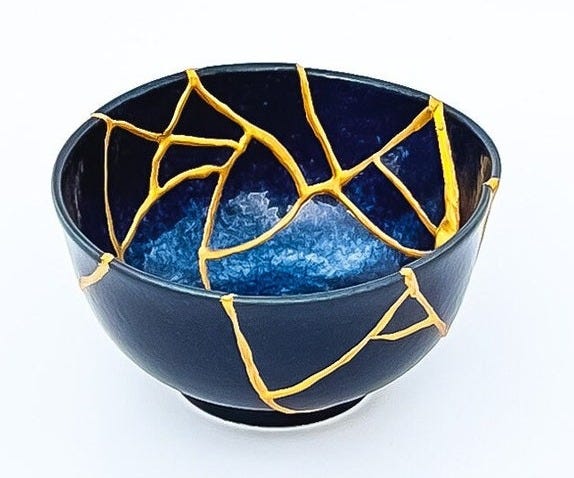
Kintsugi, a style of Japanese pottery, sees the beauty in brokenness. In the art of Kintsugi, an artist repairs broken pottery pieces by putting them back together with gold lacquer to create a new piece more beautiful and resilient than before.
My mentor was right. I am not the same piece of pottery I was when I first moved to Boulder. My body will forever hold the trauma of breaking repeatedly, but I have found so much beauty in this trauma-shattered life and I’m picking up my most resilient pieces to build something more beautiful than before.
I came to Colorado to find myself. Maybe finding myself was less about becoming who I am and more about breaking down who I am not.
I am thankful for the Boulder who broke me because in that fracturing, I learned I can trust and find home in myself.
This isn’t counting the arm I fully broke during my first Colorado winter when I slipped on the ice running down a mountain and landed straight on the proximal end of the humorous. What started as a lovely frolic through 20 inches of fresh powder up to Green Mountain (#IYKYK) ended in a five-mile sub-freezing death march back to my car where I got to experience my first $3,000 ambulance ride to the Emergency Room.
Fun fact: I’ve climbed all the Boulder Flatirons multiple times over the past seven years with the exception of Green Mountain. I’ve only climbed Green once more after this break just to prove she is my bitch.
Beautiful testimony to your growth ❤️💪🏻
Love this! Appreciate hearing the whole story and excited your back in Boulder ❤️